|
|
 |
|
5.
Do the following:
a. Explain the
differences between a block diagram and a schematic diagram.
b. Draw a block
diagram for a radio station that includes a transceiver, amplifier, microphone, antenna, and feed line.
c. Discuss how information
is sent when using amplitude modulation AM), frequency modulation (FM), continuous wave (CW) Morse Code transmission, single
sideband (SSB) transmission, and digital transmission. d. Explain how NOAA Weather Radio (NWR) can alert you to danger.
e. Explain
how cellular telephones work. Identify their benefits and limitations in an emergency.
A block diagram shows the different sections of a transmitter or receiver.
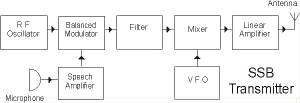
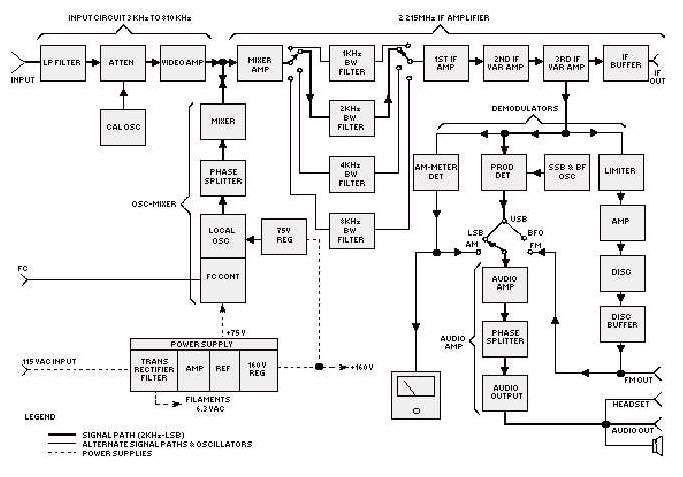
A more detailed schematic diagram shows all of the individual electrical components
used to build the radio. For more information on schematic diagrams and electronic components, you might
wish to explore Electronics Merit Badge.
Click here to see a Transmitter schematic diagram
|
|
Transmitters generate "Radio Frequency" (RF) energy. This RF energy is then modified to convey useful information.
The
simplest method to send information is to turn the transmitter on and off in recognizable pattern, such as Morse
code. This has the advantage of being simple radios to build, and is very efficient in using both electrical
power and "bandwidth". The disadvantage is the both the person transmitting and receiving the signal need to know
Morse Code. Morse Code transmissions are often called "CW" for "Continuous Wave" which
describes how the underlying signal is now generated.
But how can you send the sound of someone's voice over
radio so that an untrained person can hear it?
The first technique to be developed is called "Amplitude
Modulation" or AM. In this case, the strength of the RF signaled is varied by the sound
of the voice being placed on it. While simple to do, this requires a bit of power, occupies a bit of bandwidth,
and is subject to atmospheric noise, which often similarly AM. To reduce, the bandwidth and power needed on the HF bands,
voice communications are often done using "Single SIde Band" (SSB), which cuts the transmission in half,
and suppresses a lot of the carrier signal. The receiver then adds the carrier back using a "Beat Frequency Oscillator"
(BFO) to make the "Donald Duck" sounding signal intelligible. It does require more frequency stability and some skill
on the receiving operator, so this is mostly used for point to point communications instead of broadcasting.
For a
really good high fidelity sounding signal, which is especially important when transmitting music, "Frequency Modulation"
(FM) is used. In this case the frequency of the carrier signal is varied by the information,
instead of the amplitude. This provides a very realistic sound, but since it takes lots of power and bandwidth,
is restricted to the VHF and higher portions of the spectrum. A more modern techniques is digital transmission.
In this case, the audio signal of a voice is sliced up, sampled, measured, and converted to a numerical value
for each millisecond. This data is then sent by microchip computer on the RF as a series of on off pulses,
much like an extremely fast Morse Code. The receiving radio's microchip decodes the pattern and numbers to
recreate the voice signal in it's speaker. This has the advantage of being less prone to interference as error-correction
can be included, and also that computer data can also be sent by radio from one computer to another.
.
NOAA Weather Radio (NWR) is a series of transmitters operating near 162 MHz across the country sending weather information
direct from the National Weather Service. Many Amateur Radio handheld transceivers can receive these broadcasts, making them
doubly useful on camping trips. In addition, special NWR receivers can silently monitor the broadcasts and turn themselves
on when urgent weather danger threatens.
http://www.nws.noaa.gov/nwr/
Cellular telephones are radios. They transmit radio signals
back and forth to a cell site to make phone calls, send text messages, or data for applications. As you change location,
the your radio is transferred to another cell site along your way of travel.
For the system to work, the cell sites are connected by landline cables. This makes them vulnerable in disasters, as the
these landlines can fail and power can be lost. .
Requirement 6
|
|
|
|
|
|
|
|
|
|
|
|
|
|
|
